

I. Overview
The epoxy resin cast Dry-type Transformer material is of high quality and scientifically formulated, produced using advanced production and testing equipment according to strict processes. The product features high reliability and long service life. Depending on different usage environments, it can be equipped with enclosures of varying protection levels or not equipped with an enclosure. It can serve as an updated replacement for Oil-Immersed Transformers and is suitable for important or special environmental locations such as high-rise buildings, commercial centers, airports, tunnels, chemical plants, nuclear power stations, ships, and more.

II. Execution standard
GB1094.11-2007 Dry-type power transformer
GB/T10228-2008 Technical Parameters and Requirements for Dry-type Power Transformers
GBT17211-1998 Loading Guide for Dry-type Power Transformers
GB1094.3-2003 Power Transformers - Part 3: Insulation Levels, Dielectric Tests and External Clearances in Air
JB/T10088-2004 Sound Level of 6~500kV Transformers
JB/T56009-1998 Quality Grading of Dry-type Power Transformers
| Model | Material | Size |
| S11/S13 | Copper/Aluminum | 230*150*230cm |

III. Performance characteristics
Compared to the SCB9 model, this series of transformers exhibit lower no-load loss, no-load current, and noise.
Safe, fire-resistant, and pollution-free, it can be directly operated in the load center.
It has high mechanical strength, strong short-circuit resistance, low partial discharge, good thermal stability, high reliability, and long service life.
It has good heat dissipation performance and strong overload capacity, and can increase capacity operation when using forced air cooling.
It has good moisture resistance and is suitable for operation in high humidity and other harsh environments.
It can be equipped with a comprehensive temperature monitoring and protection system. Utilizing an intelligent signal temperature control system, it can automatically monitor and display the working temperature of each of the three-phase windings on the same screen, automatically start and stop the fan, and has functions such as alarming and tripping.
Small size, light weight, small footprint, and low installation cost.

IV. Structural characteristics
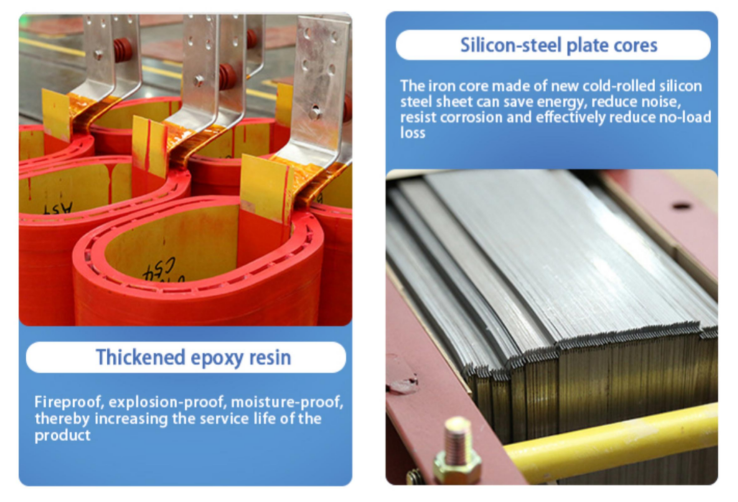
The iron core material is made of high-quality cold-rolled oriented silicon steel sheets, featuring a fully scarf joint laminated structure.
The low-voltage coil adopts a foil winding structure, wound with high-quality copper foil, while the high-voltage coil features a layered structure, molded with vacuum epoxy resin.



The 11/0.4kV, 33/0.4kV three-phase Dry-type Transformer is an important medium voltage power distribution device used to convert electrical energy from medium voltage networks into low voltage power for industrial equipment, commercial facilities, renewable energy systems, and infrastructure projects.
Unlike traditional oil-filled transformers, a dry-type transformer uses solid insulation materials instead of liquid insulation oil. This design provides advantages such as improved fire safety, lower maintenance requirements, cleaner operation, and better suitability for indoor installation environments.
The two common voltage levels, 11/0.4kV three-phase dry-type transformer and 33/0.4kV three-phase dry-type transformer, are designed for different medium voltage distribution systems. The first type is widely used in local distribution networks, factories, and commercial buildings, while the second type is commonly applied in larger power distribution projects requiring higher input voltage levels.
As a key component in modern electrical distribution systems, the three-phase dry-type transformer plays an important role in ensuring stable voltage supply, improving electrical safety, and supporting continuous operation of industrial and commercial loads.
A three-phase dry-type transformer is a static electrical device that transfers electrical energy between different voltage levels through electromagnetic induction. It consists mainly of an iron core, high-voltage winding, low-voltage winding, insulation system, and cooling structure.
The basic function of an 11/0.4kV dry-type transformer is to reduce 11kV medium voltage electricity to 0.4kV low voltage power suitable for end-use electrical equipment. Similarly, a 33/0.4kV dry-type transformer converts 33kV medium voltage input into 400V low voltage output.
The voltage designation represents the relationship between the high-voltage side and low-voltage side:
11/0.4kV: The primary side voltage is 11kV, and the secondary side voltage is 0.4kV.
33/0.4kV: The primary side voltage is 33kV, and the secondary side voltage is 0.4kV.
These transformers are commonly installed between medium voltage distribution networks and low voltage electrical systems. They provide power for motors, production equipment, lighting systems, automation equipment, and other electrical loads.
Although both transformers have the same low voltage output level, their main difference is the input voltage level and application environment. Selecting the correct transformer depends on the structure of the power network, project capacity, and distribution requirements.
| Comparison Item | 11/0.4kV Three-phase Dry-type Transformer | 33/0.4kV Three-phase Dry-type Transformer |
|---|---|---|
| High Voltage Side | 11kV | 33kV |
| Low Voltage Side | 0.4kV | 0.4kV |
| Main Application | Factories, commercial buildings, local substations | Large industrial projects, renewable energy systems, regional distribution |
| Installation Scale | Small and medium distribution systems | Medium and large power distribution systems |
| Main Advantage | Flexible installation and wide application | Suitable for higher voltage distribution networks |
Source: Comparison based on common medium voltage distribution system design practices and transformer application requirements.
The operating principle of a three-phase dry type transformer is based on electromagnetic induction. When alternating current flows through the primary winding, a changing magnetic field is created inside the iron core. This magnetic field transfers energy to the secondary winding and generates a different voltage level.
The transformer does not directly connect the input and output circuits. Instead, electrical energy is transferred through magnetic coupling, which provides electrical isolation between the high voltage side and low voltage side.
The transformer receives electrical energy from an 11kV or 33kV medium voltage distribution network. The high voltage winding carries the incoming electrical energy into the transformer.
The iron core provides a low-resistance path for magnetic flux. High-quality core materials help reduce energy loss and improve transformer efficiency.
The secondary winding generates a lower voltage output according to the winding ratio. The converted 0.4kV electricity can then supply industrial and commercial electrical equipment.
The low voltage output is connected to distribution panels, control systems, motors, and other electrical loads to provide stable power.
The performance of a Medium Voltage Dry Type Transformer depends on its electrical design, insulation system, manufacturing quality, and environmental adaptability. The following features make dry-type transformers suitable for modern power distribution applications.
One of the most important advantages of dry-type transformers is improved fire protection. Since no insulating oil is used, the risk of oil leakage and oil-related fire hazards is reduced.
This characteristic makes dry-type transformers suitable for buildings, underground facilities, transportation projects, and locations with strict safety requirements.
Many modern dry-type transformers use epoxy resin insulation. The solid insulation system provides excellent electrical strength, moisture resistance, and mechanical protection.
Compared with traditional liquid insulation systems, epoxy resin insulation requires less maintenance and provides stable performance during long-term operation.
Dry-type transformers do not require oil testing, oil replacement, or leakage inspection. This reduces maintenance work and helps lower operating costs over the transformer life cycle.
Industrial environments may include temperature changes, dust, humidity, and continuous operation conditions. A properly designed industrial dry type transformer can maintain stable performance under various environments.
Compared with some traditional transformer solutions, dry-type transformers are easier to install in limited spaces. They are commonly used in indoor substations, electrical rooms, factories, and commercial facilities.
Transformer selection depends on several important technical parameters, including voltage level, rated capacity, insulation class, cooling method, and operating environment.
| Parameter | Typical Specification | Function |
|---|---|---|
| Rated Voltage | 11kV / 33kV input, 0.4kV output | Defines voltage conversion capability |
| Phase Type | Three-phase | Suitable for industrial power systems |
| Insulation System | Epoxy resin solid insulation | Provides electrical protection |
| Cooling Method | AN / AF cooling | Controls operating temperature |
| Frequency | 50Hz / 60Hz | Matches different power networks |
| Installation | Indoor substations, electrical rooms | Flexible project integration |
Source: Technical information is summarized from transformer engineering practices, industrial electrical system design, and common dry-type transformer specifications.
The 11/0.4kV, 33/0.4kV three-phase dry-type transformer provides several advantages for modern electrical systems:
Stable voltage conversion between medium voltage and low voltage systems.
Improved safety due to oil-free insulation design.
Lower maintenance requirements compared with oil-filled transformers.
Good resistance to moisture, dust, and environmental changes.
Suitable for industrial, commercial, and renewable energy applications.
Flexible customization according to project requirements.
For medium voltage distribution projects requiring reliable operation, safety, and long service life, dry-type transformers provide an effective and practical power conversion solution.
The 11/0.4kV, 33/0.4kV three-phase dry-type transformer is widely used in electrical distribution systems where safety, reliability, and stable voltage conversion are required. Due to its oil-free structure, excellent insulation performance, and low maintenance characteristics, it has become a common choice for industrial facilities, commercial buildings, renewable energy projects, and infrastructure systems.
Different industries have different requirements for transformers. Manufacturing plants usually focus on continuous operation and load stability, while commercial buildings and public facilities pay more attention to fire safety and maintenance convenience. Dry-type transformers can meet these requirements through flexible design and reliable performance.
Industrial production depends on stable electricity supply for motors, automation equipment, processing machines, and production lines. Any power interruption may affect production efficiency and increase operating costs.
The 11/0.4kV three-phase dry-type transformer is commonly installed in factories to reduce medium voltage electricity into usable low voltage power. It provides stable energy for:
Manufacturing equipment
Motor control systems
Automation production lines
Industrial control panels
Machine tools and processing equipment
In industrial environments, transformers need to operate continuously for long periods. Therefore, electrical stability, thermal performance, and insulation reliability are important selection factors.
The expansion of renewable energy has increased demand for reliable power conversion equipment. Solar power plants, wind power facilities, and energy storage systems require transformers to connect generation equipment with medium voltage distribution networks.
A 33/0.4kV three-phase dry-type transformer is often selected for projects requiring higher voltage distribution capability. Its solid insulation structure provides advantages in environments where fire protection and environmental safety are important.
Shopping centers, hospitals, airports, hotels, and office buildings require reliable electricity for daily operation. These facilities usually have strict requirements for electrical safety, noise control, and maintenance efficiency.
Dry-type transformers are suitable for these applications because they:
Do not contain transformer oil
Reduce fire risks
Require less maintenance
Can be installed close to electrical loads
Rail transit systems, tunnels, airports, and urban transportation projects require highly reliable electrical systems. Power equipment failure may affect safety and service operation.
Three-phase dry-type transformers are commonly used in:
Railway substations
Metro power systems
Traffic control facilities
Station electrical rooms
Their stable insulation performance and compact design make them suitable for space-limited infrastructure projects.
Mining and chemical industries often operate in harsh environments involving dust, vibration, temperature changes, and continuous electrical loads.
A reliable medium voltage dry type transformer can provide stable power conversion while reducing maintenance requirements. Proper protection design allows transformers to operate effectively in demanding industrial conditions.
| Industry | Typical Application | Main Requirement |
|---|---|---|
| Industrial Manufacturing | Factory distribution systems and production equipment | High reliability and continuous operation |
| Renewable Energy | Solar, wind power, energy storage projects | Stable medium voltage conversion |
| Commercial Buildings | Buildings, hospitals, shopping centers | Safety and low maintenance |
| Transportation | Railway and infrastructure systems | Reliable operation and compact installation |
| Heavy Industry | Mining and petrochemical facilities | Environmental resistance |
Source: Application classification is based on industrial power distribution practices and common dry-type transformer installation scenarios.
The reliability of a three-phase dry type transformer depends on accurate engineering design, high-quality materials, precise manufacturing processes, and strict testing procedures.
Each production stage influences the final electrical performance, service life, and operational safety of the transformer.
Before production, transformer design starts with technical analysis according to application requirements. Engineers evaluate:
Voltage level
Rated capacity
Load characteristics
Installation environment
Cooling conditions
Protection requirements
A suitable design helps ensure the transformer can operate efficiently under actual working conditions.
The transformer core provides the magnetic path required for energy transfer. The quality of the core directly affects transformer efficiency and temperature rise.
During production, attention is given to:
Core material selection
Processing accuracy
Magnetic loss control
Mechanical stability
The winding system is one of the most important parts of a transformer. Proper winding design ensures correct voltage conversion and improves electrical stability.
The manufacturing process controls:
Winding arrangement
Conductor positioning
Insulation distance
Mechanical strength
Many epoxy resin dry type transformers use solid insulation technology to improve electrical strength and environmental resistance.
The epoxy resin insulation system helps protect the winding from moisture, dust, and mechanical stress. It also improves safety because it eliminates the need for liquid insulation materials.
After manufacturing, the transformer undergoes inspection and testing before delivery. The purpose is to confirm that electrical parameters meet design requirements.
Common testing items include:
Voltage ratio testing
Insulation resistance testing
Winding resistance testing
Load performance testing
Appearance inspection
| Control Stage | Main Inspection Item | Purpose |
|---|---|---|
| Raw Material Inspection | Core, conductor, insulation materials | Ensure material reliability |
| Production Control | Winding and assembly accuracy | Maintain manufacturing consistency |
| Electrical Testing | Voltage, insulation, performance tests | Verify operational safety |
| Final Inspection | Complete product condition | Ensure delivery quality |
Source: Quality inspection methods are based on transformer manufacturing practices and ISO9001 quality management principles.
Choosing a suitable transformer requires a detailed understanding of the electrical system and operating conditions. Incorrect selection may lead to insufficient capacity, overheating, or unstable operation.
The first step is confirming whether the power system requires an 11kV or 33kV input transformer. The transformer voltage level must match the existing medium voltage network.
Transformer capacity should be calculated according to the total electrical load. Factors include:
Motor power requirements
Starting current
Future expansion plans
Continuous operating load
The installation location affects transformer selection. Important factors include:
Indoor or outdoor installation
Temperature conditions
Humidity level
Ventilation conditions
Space limitations
For buildings, factories, and infrastructure projects with strict safety requirements, dry-type transformers provide advantages because of their oil-free design and reduced maintenance needs.
Jihui Electric Group Co., Ltd. is a high-tech enterprise specializing in the research, development, manufacturing, sales, and service of medium and low voltage power transmission and distribution equipment up to 35kV.
The company provides various electrical products, including Cable accessories, Cable distribution boxes, ring main units, Prefabricated Substations, combination transformers, SF6 load switches, and Vacuum circuit breakers.
With ISO9001 quality management certification, ISO14001 environmental management certification, and ISO45001 occupational health and safety certification, the company focuses on providing reliable, energy-efficient, and safe electrical solutions for global customers.
An 11/0.4kV dry-type transformer reduces 11kV medium voltage electricity to 0.4kV low voltage power for industrial equipment, commercial facilities, and electrical distribution systems.
The difference is the input voltage level. An 11kV transformer is used in lower medium voltage distribution systems, while a 33kV transformer is suitable for higher voltage networks and larger projects.
Dry-type transformers have no insulating oil, which improves fire safety and reduces maintenance requirements. This makes them suitable for buildings, factories, and indoor substations.
Yes. Transformer specifications such as capacity, voltage ratio, insulation design, protection level, and installation structure can be customized according to project requirements.
The 11/0.4kV, 33/0.4kV three-phase dry-type transformer is a reliable solution for modern medium voltage power distribution systems. With advantages including strong insulation performance, low maintenance requirements, high safety, and flexible application capability, it is widely used in industrial, commercial, renewable energy, and infrastructure projects.
Understanding transformer structure, operating principle, technical parameters, and application requirements helps engineers and buyers select the most suitable power distribution solution for their projects.
JiHui Electric Group Co., Ltd , high-end website construction, foreign trade website construction, marketing website construction, website optimization, development websites, corporate network marketing, search engine promotion, wechat mini program, corporate mailbox, short video operation, etc.
No. 161 Jingliu Road, Yueqing Economic Development Zone, Yueqing City, Zhejiang Province, China
jh.power@jihuielec.com
+86 18967711755

Copyright © JiHui Electric Group Co., Ltd All rights reserved
SitemapThis website uses cookies to ensure you get the best experience on our website.
 Español
 Portugues
 Pусский
 Français
 Deutsch
 日本語
日本語 한국어
한국어 العربية
 Italiano
 Nederlands
 Svenska
 Polski
 ไทย
ไทย Türk dili
 हिन्दी
 Indonesia
 Tiếng Việt
 עִברִית
 čeština



 Phone
Phone